Search This Blog

Monday, December 25, 2017

Five Signs You Have A Cavity (And What You Need To Do)

Cavities, or dental caries, are one of the most common health problems faced around the world, second only to the common cold. If not treated, cavities can cause infection, toothache and ultimately total tooth loss.  Wondering if you have one?  Here are five symptoms to watch out for:

1. Bad Breath
If tooth decay is ignored, bacteria will proliferate, causing bad breath.  If you are brushing and flossing regularly, yet still notice you have bad breath, you need a check up.

2. Bad Taste in your Mouth
If you notice a chronic bad taste in your mouth, get your teeth checked out as it may be a sign that a cavity needs to be cleaned and filled.

3. Tooth Sensitivity or Pain
A sensitive or painful tooth, even if it's only when exposed to hot or cold, can mean a cavity. Sensitivity and pain are usually evidence the cavity has progressed.  


4. Dark or White Spots
When cavities have progressed, they can become visible to the eye, appearing as a dark or white spot on the infected tooth.

5. Holes in Your Teeth
Sometimes you can see a hole on top of the tooth or feel it with your tongue.  This is not a good sign and you need to schedule an appointment right away for treatment.

6. Pus, Swelling or Extreme Pain
These symptoms may indicate an abscessed tooth. The pus is caused by a bacterial infection inside the tooth from untreated tooth decay. It can cause fever, pain and swollen glands and requires immediate medical attention as it will spread throughout your jaw.

The best time to catch a cavity is in the early stages, when there are few, if any, symptoms.  That's why a twice-yearly dental cleaning and exam is important. Unlike the common cold, y
our cavity will not get better on its own – it will only worsen, becoming more painful, time consuming and expensive to treat, and more likely to impact the integrity of your tooth. 

Good oral hygiene, which includes brushing twice a day with a fluoride toothpaste,  flossing once a day, and having regular dental cleaning and check ups, will keep you cavity free.   Is it time for your dental appointment? Call us at 919.755.3450 or schedule online.

Thursday, December 14, 2017

Are Your Gums Receding? Learn More About Causes and Treatments

At the risk of being obvious, our gums, also known as the gingivae, are the moist pink tissue in the mouth that meets the base of the teeth. We all have two gums - one for the upper, and one for the lower set of teeth. The gums tightly surround the teeth and are firmly attached to the jaw bone. They cover and protect the delicate roots of the teeth.

But sometimes things go wrong and your gums start to receded. Think of a houseplant. If you were to take soil away from its roots, what would happen? Sooner or later, the roots would be exposed to air. They could no longer get the water and nutrients they need. Eventually, the plant would become weak, its roots would fall apart, and the plant would die.

Gum recession works much the same way. It’s a process where the gum tissue start to pull away from the teeth, exposing the fragile, sensitive tooth roots. Eventually, gums can shrink so much that the roots are almost completely exposed. This robs them of nutrients and leaves them open to attack by bacteria, as well as makes them very sensitive.  
If left untreated, gum recession can become so severe that it is irreversible and can lead to tooth loss.

You Can See and Feel Gum Recession

The first sign of gum recession is often tooth sensitivity or sore gums. Also, if you run a finger over your gums you can often feel a notch where your gumline used to be. Another sign of receding gums is that your teeth appear longer or the spaces in between them appear bigger at the base.  Compare your gums to the pictures below.  The picture on the left shows healthy gums, and the picture on the right shows gums that are receding, with inflammation and spaces noticeable between the teeth.  Whether you feel or see the onset of gum recession, it’s time to call your dental office and schedule an appointment. 

What Causes Gum Recession?

  • Poor oral health. Periodontal, or gum, disease is the most common cause of gum recession. Periodontal disease is caused by bacteria-laden plaque at the gum line. The bacteria produce acids that damage your gums resulting in the loss of this supporting tissue around the teeth. 
  • Brushing or flossing too hard. Yes, brushing too hard is possible. Always use a toothbrush that is labeled “soft.” Be gentle on your teeth, and remember that taking care of them isn’t supposed to hurt. 
  • Genetics. Like the rest of your body, your gums’ characteristics are influenced by your genetics. 
  • Dental work. Yep - sometimes dentists don't get it right on the first try. You may have an improperly fitting crown or bridge that is impacting your gums and causing recession. 
  • Abnormal tooth positioning. If your teeth are not in alignment with one another, gum recession is more likely.
  • Grinding your teeth. Teeth grinding can cause a number of dental problems including gum issues. 
  • Trauma to gums. Your gum tissue may recede due to a traumatic injury - this can include a lip or tongue piercing that impacts your gums. 


Healthy Gums Are A Team Effort

As always, prevention is the best strategy.  The simple steps you learned in childhood -  brushing twice a day, daily flossing, and having twice yearly dental cleaning and exams - will keep your gums healthy and prevent gum recession.  If recession has already started, you and your dentist need to identify and eliminate the cause.  In some cases this may be as easy as switching to a soft bristle toothbrush, correcting an improperly fitted bridge or improving your oral hygiene.  In other cases, for example, recession due to periodontal disease or trauma, your dentist may discuss some treatment options such as:
  • Desensitizing treatments: Your dentist may use varnishes or other dental products to reduce any sensitivity that may have developed in the exposed tooth root. Treating the sensitivity helps patients continue their oral hygiene routine.
  • Composite restoration: In some cases, your dentist may use tooth-colored composite resins to cover the root surface. 
  • Orthodontics: If the recession is due to misaligned teeth, orthodontic treatment which re-positions the teeth can correct the problem.
  • Deep cleaning. Your dentist or dental hygienist will use special tools to remove the plaque and tartar buildup on the roots where the gums are receding, a procedure known as root planing.
  • Gum grafting. This involves taking the patient’s own healthy gum tissue from the roof of the mouth or using a gum grafting material to replace the missing gum tissue. Your dentist may recommend you see a periodontist.
Contact us with any concerns you may have, such as tooth sensitivity, or a change in the appearance of your gums - we want to see you sooner rather than later.  We can be reached at (919) 755-3450 or schedule online.

As always, thank you for reading our blog - feel free to comment or share it with friends or family members who may be concerned about receding gums.  


Monday, November 6, 2017

Why Middle Aged Adults Avoid the Dentist: Cost and Fear Are Big Factors

Are you embarrassed by the condition of your teeth? Do you have dental problems that are causing pain, difficulty eating, or missed work? Have you been skipping your regular preventive dental cleanings?

If you answered "yes" to any of these questions you're not alone. The dental health of middle-aged Americans faces a lot of problems right now according to new results from the University of Michigan National Poll on Healthy Aging.

Here are some of the surprising statistics:
  • Thirty percent of Americans between the ages of 50 and 64 say they're embarrassed by the condition of their teeth.
  • A slightly larger percentage say dental problems have caused pain, difficulty with eating, missed work or other health problems in the past two years.
  • Forty percent of Americans don't get regular cleanings or other preventive care that can help them avoid dental problems.
Why don't people get needed dental care? Cost was the most commonly reported answer, given by 69 percent who said they did not get, or delayed, needed care. One in five cited fear of the dentist as a major factor for not receiving care.

Insurance coverage has a lot to do with this lack of care. Nearly one-third of those surveyed did not have dental insurance and one-half did not know how they will get dental insurance coverage after they turn 65.

Creating Opportunities To Help Our Patients

"Oral health is a critical factor in overall wellness - for example, people with periodontal disease are at greater risk for Alzheimer's Disease, stroke, certain cancers, and rheumatoid arthritis" states Dr. Jeff Morrison, of Jeff M.Morrison & Assoc., DDS. This research helps us identify some key issues -- such as lack of insurance coverage and dental fear -- which may be keeping patients from the receiving the care they need. It also allows us to create opportunities to encourage these patients to come in."

"For example, because regular preventive dental care and early treatment for problems can be out of reach for those without dental insurance, we created the St. Mary's Street Dental Savings Plan. This in-office plan covers the cost for annual preventive care and offers a significant savings off all other treatment throughout the year. We also offer a variety of payment options, including Care Credit dental financing." says Dr. Morrison.

"We also understand that fear keeps many people from the dentist, and our entire staff works hard to address the anxiety and concerns among patients of all ages."

Are you delaying needed preventive care or treatment - for any reason? Give us a call at (919) 755-3450 and let our friendly staff help you find a solution. You can also go online and schedule.

Story Source:  Michigan Medicine - University of Michigan. "Tooth trouble: Many middle-aged adults report dental pain, embarrassment and poor prevention: More than 1 in 4 lack dental insurance now, and half don't know how they'll get it after age 65, U-M/AARP National Poll on Healthy Aging finds." 

Monday, October 30, 2017

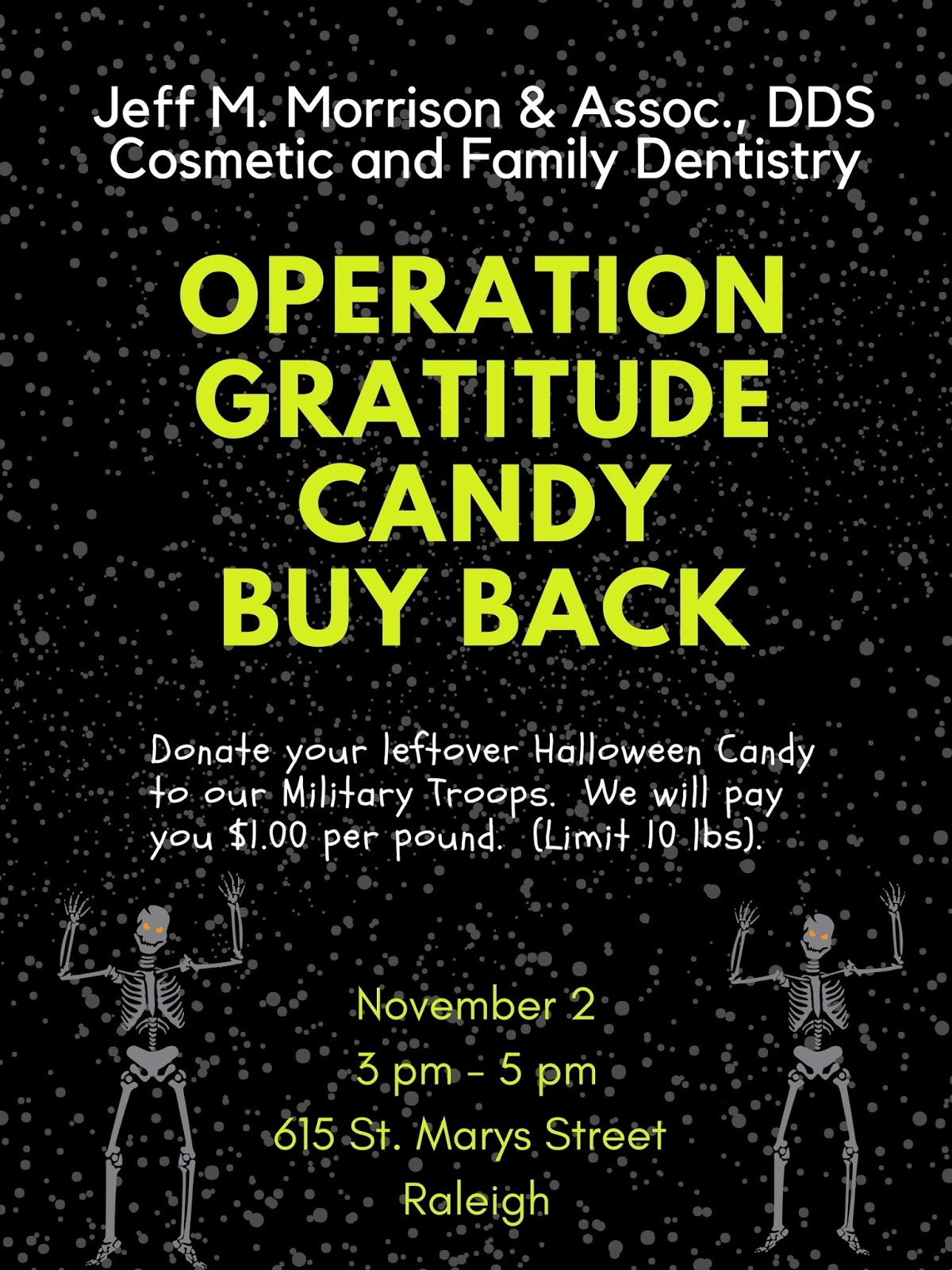
Halloween Candy Isn’t So Scary: Our Candy Buy Back Program and More

Ok, admit it – when the kids bring home those plastic pumpkins overflowing with treats, you’re just as excited as they are to dig in. But then, after the initial burst of excitement, you’ve got PILES of the stuff left. What do you do with it all when you’re trying to maintain a healthy diet (not to mention healthy teeth) for your family?
We've got an idea - DONATE IT to our Military Troops.  This year Jeff M. Morrison & Associates DDS is participating in the Operation Gratitude Candy Buy Back Program.  Between November 2 and 7, bring your children, along with their candy, to our office at 615 St. Mary's Street. Their candy will be weighed and kids will receive $1.00 for every pound they donate.  
Tips For Managing All That Sugar
While we definitely want you to participate our Operation Gratitude Candy Buy Back, we agree with this Psychology Today blogger that the yearly candy bonanza is a great opportunity to teach kids how to enjoy tasty treats in moderation. Here are a few of our favorite tips from the Boston Mamas blog on “How to Handle the Halloween Candy Craze.
  1. Real food first. Make it a rule: eat a nutritious dinner (ideally including fruits and veggies) before candy happens.
  2. Teach moderation. Remind kids to monitor how their tummy feels while they’re eating; if they’ve had a past experience of overindulgence making them sick, it’s a good idea to remind them of how yucky that felt, so they’ll practice noticing how they feel when they eat.
  3. Set firm limits, and be consistent. Decide how much the kids are allowed to have and when – say, 1-2 pieces after a meal – and never bend to whining! Kids are smart, and if they realize that whining works, they’ll do it every time.
  4. Make candy-eating contingent on immediate tooth-brushing. Not only is this the best practice to prevent cavities, but it’s also a good way to make eating candy a little annoying.  It’s amazing how the nuisance of teeth brushing (not at the typical teeth brushing times) will kill the desire for eating that mini Snickers. But even if it doesn’t, it’s always a good thing to follow candy consumption with teeth brushing.  
  5. Limit the drama. Kids feed off our emotions. The bigger a deal you make of it, the more they will want it. Just be matter of fact about your decisions and limit the drama.
  6. Teach about consequences. If candy consumption really becomes a difficult issue, teach your kids about consequences.  Toss it!  Or, give it away via a local buy back or donation to the troops. Trust me, they will remember next year.
  7. Change the giving rules in your home. If you want to model less candy, try passing out Halloween candy alternatives. It will show them that there can be other ways to celebrate.
There are tons of other great resources on the internet loaded with tips on how to control and limit candy consumption. One of my personal favorites is this roundup on Babble of cool science experiments you can try with Halloween candy.  Is it more fun to eat Pop Rocks, or to use them to blow up a balloon? My kids went with the balloon (who really likes the taste of Pop Rocks, anyway?)  Another great idea - re-purposing the Halloween candy by using for a holiday advent calendar.

There are also great treats to hand out instead of candy - such as glow-necklaces (helps cars see little trick or treaters!), stickers, temporary tattoos, and plastic fangs - all irresistible to small children. I also endorse the approach of one clever mama who offered both candy AND toys, so trick-or-treaters could choose; she found that loads of kids went with the toys instead!  Check out your local Dollar Store for little items that may be good substitutes for candy.

Let us know your ideas for handling the Halloween candy craze.  Is it time for your next cleaning and exam?  Give our office a call at (919) 755-3450.   We look forward to seeing you!  


x

Wednesday, October 25, 2017

Sedation Dentistry: What You Need to Know

If you shudder at the thought of a dental visit, or avoid it altogether, you're not alone. Dental anxiety is very real and it's estimated that up to 20% of people avoid seeing the dentist because of anxiety and fear. At Jeff M. Morrison & Associates DDS, we want you to take excellent care of your oral health - which means coming in for regular cleaning and exams, and having dental problems addressed at the earliest possible stage. That's why we offer sedation dentistry to those who need extra help feeling calm and relaxed during a dental procedure.

We will administer a controlled amount of sedative medicine before or during your dental procedure, helping to reduce your anxiety and create a calm treatment experience.  Whether you are getting your wisdom teeth removed, a cavity filled, or simply a routine cleaning and exam, we will work with you to assure that you are comfortable, calm and relaxed.


Sedation dentistry is divided into different categories. Minimal sedation, which decreases anxiety while maintaining full consciousness, can be achieved through mild anti-anxiety medication or nitrous oxide. Moderate, or conscious, sedation is commonly achieved through a combination of sedative pills and an intravenous sedative. It creates a sleeplike state in which the patient's response to touch and sound is strong. Intravenous sedation allows you to sleep deeply in an unconscious state where you will not be awakened until the effects wear off or medication is used to reverse it.

At Jeff M. Morrison & Associates, DDS, our patients’ comfort is our priority. We offer two types of minimal dental sedation to help you feel completely relaxed before, during, and after your visit to our office:

  • Inhalation Sedation (or Laughing Gas) is a combination of nitrous oxide and oxygen that you breathe in through a mask placed over your nose to help you relax. The amount you receive is controlled by Dr. Morrison. This form of sedation wears off quickly.
  • Oral Conscious Sedation is in the form of a prescribed pill that is taken about an hour before your dental procedure. With this form of sedation, you remain conscious and completely aware of your surroundings in a very calm and relaxed state. A variety of medications are available for this type of sedation, and Dr. Morrison will carefully discuss your particular needs to determine which choice would work best for you. However, all are classified as anti-anxiety medications and achieve the same result: reducing and even eliminating the anxiety of dental treatment.

Inhalation sedation and oral conscious sedation can safely be used together for an even deeper feeling of relaxation.

Is Sedation Dentistry Right For You?

Here are a few things to discuss with Dr. Morrison when considering sedation dentistry: 
  • Is the procedure lengthy or complex? Sedation dentistry may allow us to complete your treatment in fewer appointments and to finish complex procedures in less time.
  • Do you have a psychological or physiological reason (such as a highly sensitive gag reflex) that makes dental procedures difficult? Sedation dentistry may successfully address these reasons by allowing you to relax deeply through the procedure. 
  • Do you have any serious health conditions, or are you pregnant? Using sedatives during a dental procedure may not be a good idea for people who are pregnant, or who have certain cardiac or respirator conditions. 
While your dental treatment is performed, your vital signs will be carefully monitored to ensure that your experience is as safe as possible. If you've only received nitrous oxide, the effects will wear off almost immediately and you will be able to drive home, or return to work or school. The effects of oral sedation last longer than with nitrous oxide alone, so you'll need someone to drive you home after your procedure. Unexpected reactions to inhalation or oral sedation are exceedingly rare, but as with any medical procedure, Dr. Morrison will review your health history, discuss the risks and benefits, and carefully monitor you throughout the procedure for any changes in blood pressure, heart rate and oxygen levels.

"It’s normal to experience some apprehension about going to the dentist, especially if you've had a negative experience at the dentist as a child, or if you’re heading into an extensive procedure" says Dr. Morrison. "Before I offer the option of sedation - I try to find out the source of the patients' anxiety and their level of anxiety, and then we talk about ways to manage it," he said. "I can oftentimes get an anxious patient comfortably through a procedure just by talking with them, distracting them, taking breaks, and explaining what we are doing at each stage of treatment." 
"However, some patients simply won't get the care they need unless they have some kind of sedation and in these cases the risks of not receiving dental care is greater," said Dr. Morrison. "For these patients, using sedation dentistry to help them face their fears and get the treatment they need is essential."

At Jeff M. Morrison & Associates, we do what we can so all patients feel completely comfortable in our office— no matter how big or how small their treatment may be. Is it time for your cleaning and exam? Give our office a call at 919.755.3450 or schedule online. We look forward to seeing you.


Friday, October 6, 2017

PROPER BRUSHING FAQs

Mouth open or mouth closed? After lunch or after dinner? Flat or at an angle? We've been brushing our teeth just about every day (hopefully) since our teeth came in.  Who knew it was so complicated?   

Fact is, there are actually some best practices to be mindful of when brushing those pearly whites. In our world of alternate facts, fake news, and lists of “7 Ways to Keep Your Teeth Clean Without Picking Up a Toothbrush” it's easy to be confused about the correct way to brush.  

Don't worry - we’ve got you covered with this handy FAQ (frequently asked questions) guide. We’ll keep it simple with some easy dos and don’ts of brushing. Let’s get to it! 

Don’t: Keep your brush flat 
Do: Use a 45-degree angle when brushing 

Don’t: Use looooooooong strokes. No need to cover your whole mouth in one stroke! 
Do: Use short, side to side strokes 

Don’t: Brush with the force of a giant
Do: Gently cover all areas. A gentle touch helps prevent wear and tear on your enamel 

Don’t: Go one and done 
Do: Brush at least twice a day, especially after eating or drinking something acidic (like citrus or soda) 

Don’t: Be sentimental and use the same toothbrush for life 
Do: Change your toothbrush every 3-4 months. A trick to remember: switch out on the first day of each season 

Don’t: Be average – the average person brushes their teeth for 45 seconds 
Do: Brush for a full 2 minutes. A helpful trick: say the alphabet while brushing a certain section, move to the next section after you hit Z 

Don’t: Keep your toothbrush in a closed container 
Do: All your toothbrush to air dry 

Don’t: Store your toothbrush on the sink counter where bathroom particles can get on it 
Do: Store your toothbrush in the medicine cabinet 

Don’t: Use a tough-bristled brush 
Do: Use a soft-bristled toothbrush, which is much better for your tooth enamel 

And there we have it! Some easy practices to keep that perfect smile. Remember: Brushing is only 4 minutes out of the day, so why not make it great?  If you have questions about brushing, ask our friendly Dental Hygienists at your next check up.  Need to schedule?  Give us a call at 919.755.3450 or schedule online at www.jeffmorrisondds.com.


Monday, September 18, 2017

Seven Steps to Take This Fall for Better Dental Health


  1. Clean Out that Mouth! If you’re a homeowner, you’re probably thinking about cleaning out your gutters this time of year. The same goes for your teeth – particularly if it's been awhile since your last cleaning. So, pull out your calendar and give us a call or go online to schedule an appointment.  
  2. Replace Your Toothbrush: Homeowners and renters are familiar with the drill of replacing heating and air conditioning filters, or batteries in your smoke detector, with the change of seasons. This is also a great time to switch out your toothbrush. Here are a few tips on choosing the right toothbrush to make sure you pick the right one.
  3. Pick up a Pack of Xylitol Gum: This is one little secret that’s starting to catch on. Use a sugar-free gum that contains Xylitol – a natural sweetener derived from plants. It doesn't break down like sugar and can help keep a neutral pH level in the mouth. Both of which can help you avoid cavities.
  4. Eliminate a Habit: Whether it’s smoking, acidic beverages, or chewing tobacco, try eliminating a habit that does harm to your teeth. Doing so now is a good idea because outside the holidays, there are fewer demands on your willpower reserves, making a successful effort that much more likely.
  5. Pick up a GOOD Habit: There are a lot of great dental habits you can pick up that benefit your teeth year-round, like wearing a night guard if you grind your teeth at night, going with better food choices, or wearing a mouthguard if you play sports. 
  6. Buy Yourself - or Someone You Love - an Early Holiday Gift: Why wait until the holidays to spoil yourself or a loved one? Start now by picking up a dental care tool to make your (or their) teeth look great, gums feel great, and breath smell great! There are a lot of options that are easy on your budget, including teeth whitening, electric tooth brushes, interproximal brushes, dental irrigators, and even tongue scrapers!   Do you know someone in need of dental care?  Buy them a year of preventive dental care with the St. Marys Dental Savings Plan.  
  7. Check in on Your Insurance Benefits: Don't let your dental benefits go unused. In most cases any unused portion is lost when your new insurance year starts, even though you have already paid for them! And, don’t forget, many of those dollars can be used for items other than actual exams.  Not sure if you have remaining dental benefits?  Give our office a call - we can tell you and also schedule that exam or treatment you have been putting off.  

Questions?  Need to schedule an appointment?  Give our friendly staff at call at 919 755 3450.  We look forward to seeing you in the office!